
Competitive Entrance Exams: The Complete 90-Day Preparation Blueprint
Competitive entrance exams are some of the most demanding tests a student will face — often only a fraction of applicants clear them. The gap between those who clear and those who don't is not intelligence. It is strategy. This is the 90-day plan that works.
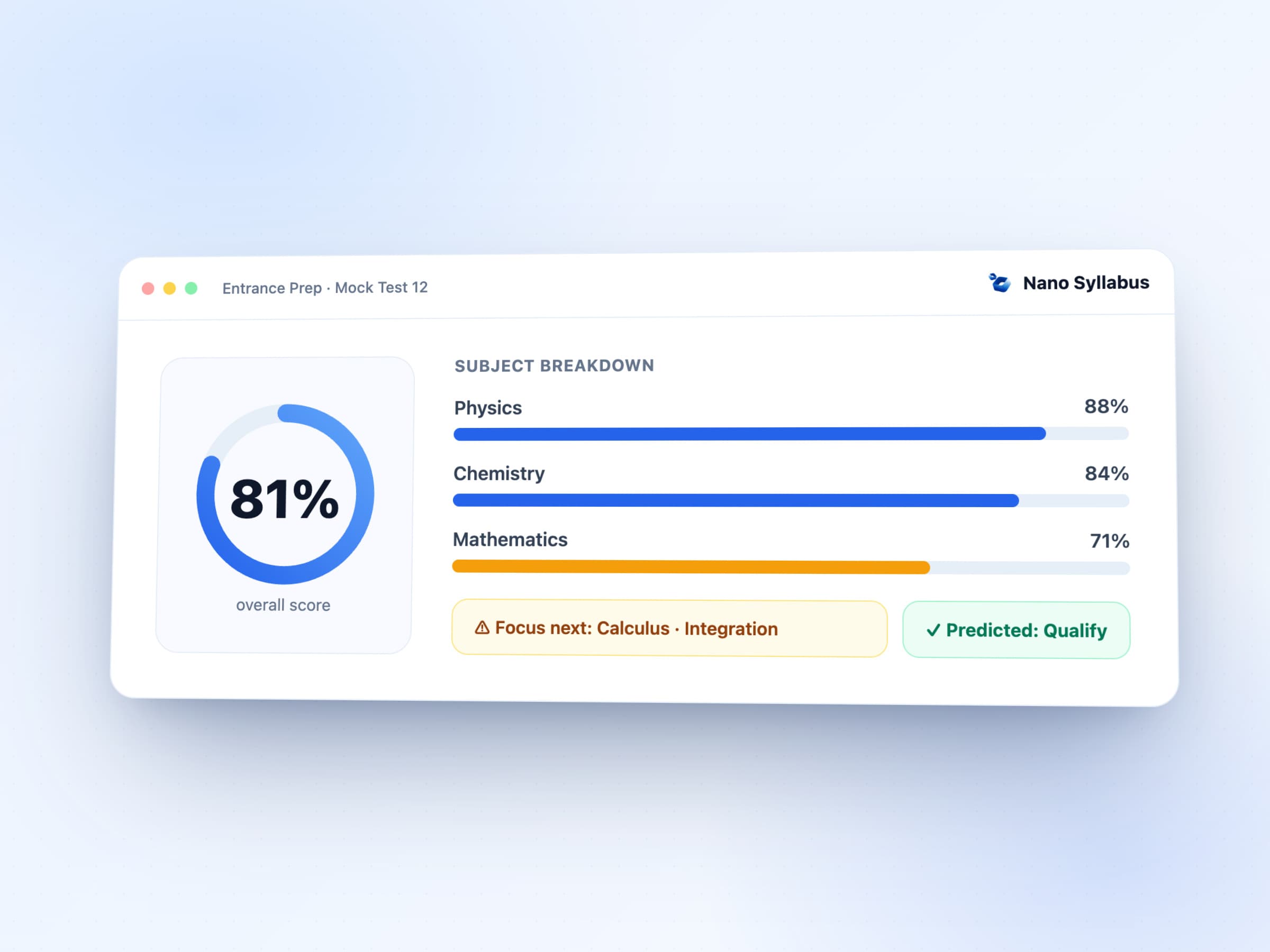
Understanding What the Exam Actually Tests
| Subject | Typical weight | Why it matters |
|---|---|---|
| Physics | High | Most discriminating; rewards understanding over memory |
| Mathematics | High | Speed and accuracy separate top ranks |
| Chemistry | Medium | Scoring if you drill reactions and concepts |
| Language / Reasoning | Lower | Easy marks most students leave behind |
Most STEM entrance exams weight a handful of subjects — typically physics, chemistry, mathematics, and a language or reasoning section. Mark distribution varies, but the pattern is consistent: a few subjects carry most of the weight.
The key insight: the high-mark, high-discrimination subjects decide your rank. Students who score well there almost always clear. Students who neglect them almost never do.
Month 1 — Build Your Foundation
Start by taking one past paper without preparation. Time yourself and score it honestly. This tells you your baseline and, more importantly, which chapters are bleeding marks. Then work through high-weight chapters first — in physics: mechanics, electricity and magnetism, and waves and optics. In maths: limits and derivatives, integration, coordinate geometry, and vectors.
For each chapter, follow the same loop — read notes, solve 10 practice questions, check answers, and understand every wrong one before moving forward. In chemistry, focus on equilibrium and thermodynamics, organic chemistry, and electrochemistry.
Month 2 — Pattern Recognition Through Past Papers
Entrance exams reuse question formats relentlessly. A student who has seen 200 past questions recognises patterns before they finish reading new ones. Work through the largest past paper bank you can find and track which chapters appear most often, which question types you consistently get right, and which ones you consistently get wrong.
Dedicate one full week to your two worst chapters. Fixing a consistently-wrong chapter is worth several extra marks on exam day — this is the highest-leverage week in the entire plan.
Month 3 — Build Exam Speed
Most entrance exams give you barely over a minute per question. Students who have not practised timed conditions routinely run out of time on questions they know the answers to.
Sit three full mock papers per week under strict exam conditions: full timer, no phone, no notes. Target a steady climb in your mock scores through Week 11. Stop heavy practice three days before the exam and review key formulas and definitions only — nothing new.
Physics: The Subject That Decides Your Rank
Physics is where most candidates either pull ahead or fall behind. The students who ace it share three habits. They derive rather than memorise — understanding where a formula comes from means they can reconstruct it under pressure. They draw diagrams for every problem, even when the question does not ask for one. And they know the trick questions cold.
Entrance exams love edge cases: what happens to acceleration when mass doubles, which direction current flows in a given circuit. If you have seen that pattern five times, it takes five seconds on exam day. If you have not, it takes five minutes you cannot afford.
The Common Mistakes That Kill Scores
Starting too late: students who clear on their first attempt typically start three to four months out. Starting three weeks before is almost never enough. Ignoring the easy sections: language and reasoning marks are the cheapest points on the paper — do not leave them behind.
Practising without reviewing: solving past papers without analysing your mistakes teaches nothing. Every wrong answer is a lesson, so do not skip the review. Over-studying comfort subjects: time spent on weak subjects yields four times the return of grinding topics you already know well.
How to Use Nano Syllabus for Entrance Prep
Nano Syllabus's entrance preparation product adapts to whichever exam you are sitting. Use it to get step-by-step walkthroughs for any past paper question, quiz yourself on any chapter until it is locked in, and ask follow-up questions when the first explanation does not click.
Point it at your exam and it learns the question bank. Try asking: give me 5 questions on circular motion in the style of my entrance exam. It practises with you in the language your exam is written in, so your answers are precise under pressure. Start free at nanosyllabus.com.
Frequently Asked Questions
How hard are competitive entrance exams?
They are among the most competitive tests students face — often only a fraction of applicants clear each year. They typically test physics, chemistry, maths, and a language or reasoning section under tight time pressure.
How many months should I prepare for an entrance exam?
Three months of structured preparation is the standard for first-attempt success: one month of chapter mastery, one month of past paper pattern recognition, and one month of timed mock exams.
Which subject is most important for entrance exams?
Physics and maths are usually the most discriminating subjects and carry the most weight. Students who score well in both almost always clear. The remaining subjects should not be neglected, since they are often the easiest marks to secure.
Can I use AI to prepare for an entrance exam?
Yes. Nano Syllabus adapts to your specific entrance exam. It provides step-by-step solutions for past paper questions, chapter-by-chapter quizzes, and explanations in your preferred language to help you prepare efficiently.