How to Score Top Grades in Your Major Exams: The AI-Powered Study Guide
Every year, millions of students sit their major exams wondering the same thing: am I actually ready? The honest answer, for most students, is no — not because they have not studied, but because they have been studying the wrong way. This guide gives you a smarter path, built around the habits of students who consistently score at the top.
Why the Traditional Approach Fails
Most exam syllabuses are wide. Every subject demands a different strategy, yet the average student tries to cover everything equally, which means nothing gets covered deeply.
The students who score at the top do something different. They identify their weak chapters early. They drill past paper patterns. They review actively, not passively.
Phase 1 — Diagnose Your Gaps First (Weeks 1–2)
Before you open a textbook, find your gaps. Take one past paper under timed conditions for each subject. Mark every question you got wrong or guessed. Group your errors by chapter — for example, quadratic equations in maths or respiration in biology.
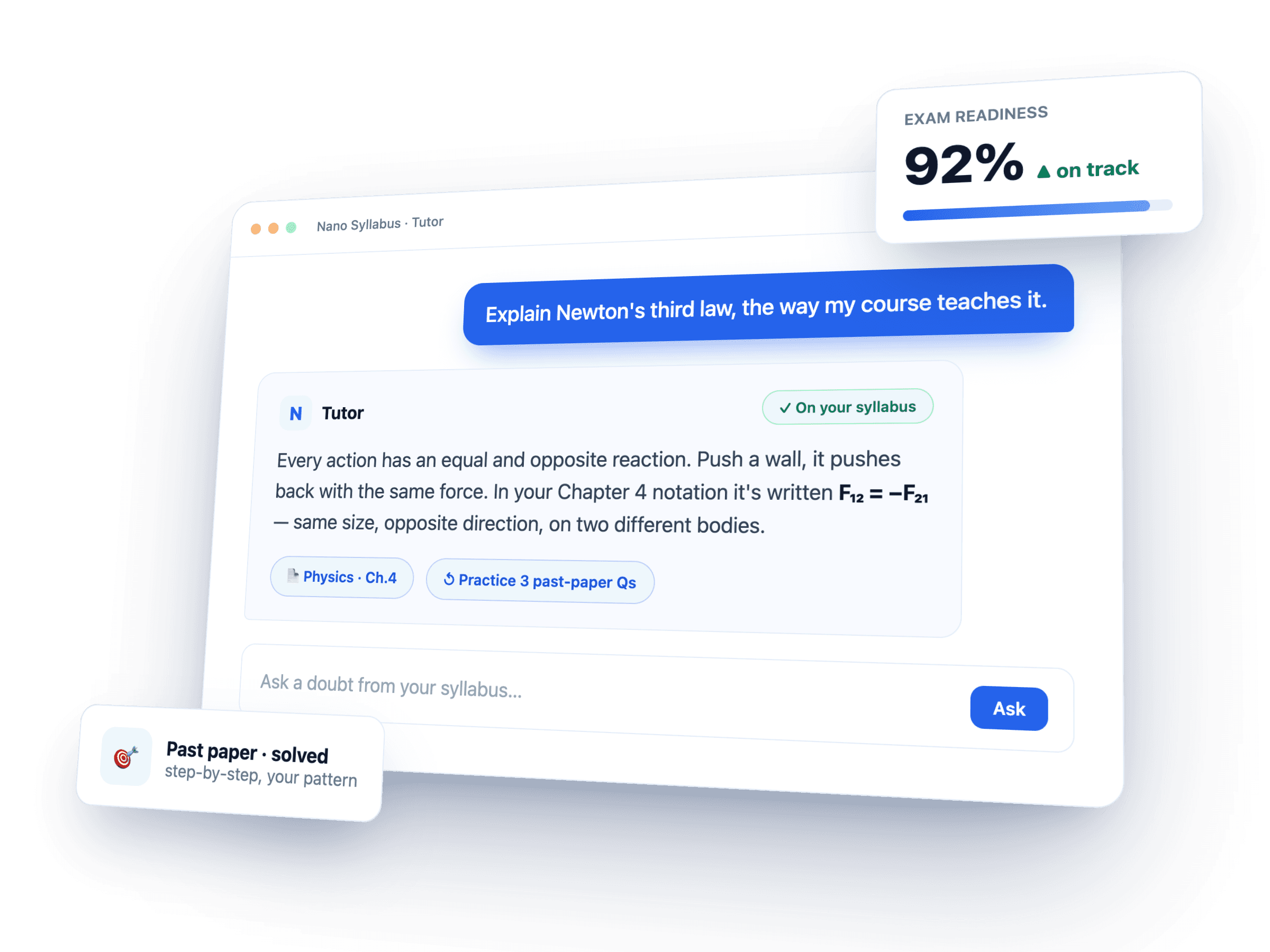
This gives you a personalised weak-spot list. With Nano Syllabus, ask the AI to quiz you on any chapter. It learns your exact syllabus chapter by chapter and surfaces the question types that appear most often in your papers.
Phase 2 — Targeted Practice by Subject (Weeks 3–10)
Work through subjects in order of your gap size, starting with your weakest. In maths, prioritise the highest-weight topics — they often account for over 60% of marks. Solve at least 3 past paper questions per chapter before moving on and never skip working; many marks come from method, not just final answers.
For science subjects, use diagrams. Labelled diagrams take ten minutes to practise and frequently appear for several marks. For language papers, practise reading comprehension timed and review core grammar rules — they appear in every paper.
Phase 3 — Mock Exam Sprints (Weeks 11–12)
Two weeks before your exam, shift into simulation mode. Sit one full mock paper per subject under strict conditions — no phone, timer running, answers written in order.
After each mock, review every wrong answer the same day. This builds exam-day stamina and trains your brain to retrieve knowledge under pressure rather than only in comfortable study sessions.
The 5 Study Habits That Separate Top Students
Study in blocks, not marathons — 45 minutes on, 10 minutes off. Write before you read: try to answer a question from memory first, then check the textbook. Retrieval beats re-reading every time. Use active recall daily through flashcards, self-quizzing, or explaining a concept out loud.
Treat past papers as primary, not supplementary: exam boards reuse question formats, and if you have seen a format five times you will recognise it on exam day. Ask when you do not understand — immediately. Letting confusion sit for a week means carrying it for a week.
How Nano Syllabus Helps You Prepare
Nano Syllabus is not a replacement for studying — it is an upgrade to how you study. Use it to get instant explanations for anything you do not understand in your own textbooks, solve past paper questions with step-by-step walkthroughs, and generate personalised flashcards from topics you keep getting wrong.
The AI adapts to your language preference and gives examples from your actual syllabus. It never gets impatient when you ask the same question ten different ways. Start free at nanosyllabus.com.
Frequently Asked Questions
How early should I start preparing for a major exam?
Three months of structured preparation is enough for most students. The key is starting with a diagnostic phase, not with random reading. Two to three months of targeted practice followed by two weeks of mock exams covers the full plan.
How many months of preparation is enough?
For most major exams, three focused months works: one month diagnosing gaps and mastering weak chapters, one month on past paper pattern recognition, and one month of timed mock exams.
Which subjects are usually the hardest?
Most students find maths and the sciences the most challenging because they require both conceptual understanding and accurate calculation. Consistent past paper practice and chapter-by-chapter gap analysis reduce difficulty significantly.
Can AI help with exam preparation?
Yes. Nano Syllabus is an AI study tool that learns your exact syllabus. It explains chapters in your preferred language, generates practice questions from past papers, and helps students identify and fix weak spots before exam day.